|
※サムネイル画像をクリックすると拡大画像が表示されます。
X-Gal (Beta-Galactosidase Substrate)
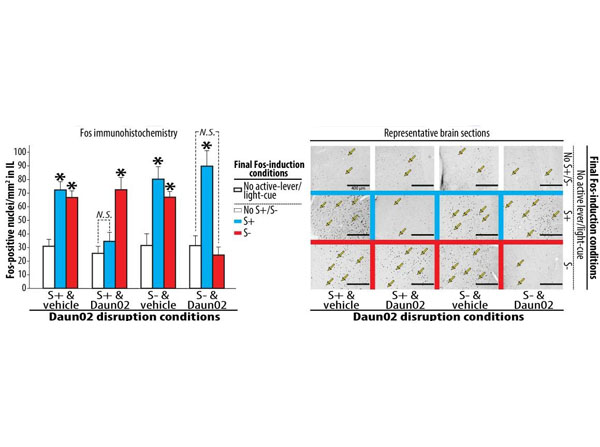
Neural ensembles in IL reactive to S+ or S- following the activity-targeted disruption by Daun02. Each of the four experimental groups, prepared and used for the Daun02 disruption and Post-disruption tests I, was further randomly divided into three groups defined by the type of final Fos induction condition (S+, S- or No S+/S-). The rats were exposed to S+, S- or No S+/S- (control), then deeply anesthetized and euthanized. Brains were collected, sectioned (40 μm), processed for Fos immunohistochemistry. Fos-positive nuclei from sampling areas around the IL microinjection sites were quantified double-blindly. X-gal (p/n XGAL-0100). The average numbers of Fos-positive nuclei per mm2?were calculated for each rat and used for statistical analyses. Yellow arrows represent typical Fos-positive nuclei. Group means of these average numbers (+SEM) are depicted. N?=?7?9, each. *p<0.05?0.01 (vs. No active lever/light-cue). Figure 3. PMID: 27938664.
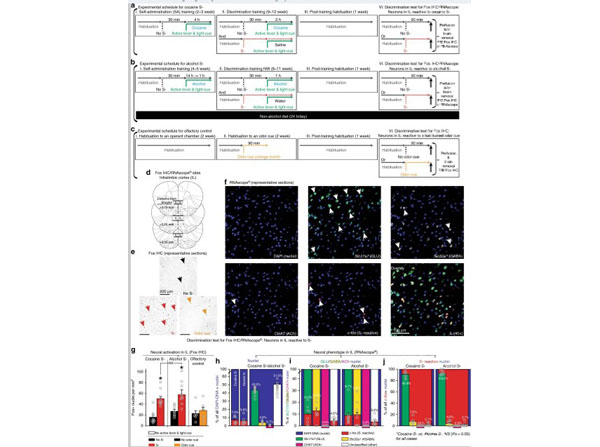
Omission cue-induced suppression (OCIS) procedures for localization and phenotypic characterization of omission cue-reactive neurons in IL. All data are mean and SEM. Gray open circles on bar charts depict individual data-points.?a,?b,?c?Timeline and schedule.?d?Target sites.?e,?f?Representative sections.?g?Effects of cocaine S-, alcohol S-, and well-habituated odor on neural activation in IL as indicated by Fos immunohistochemistry.?n?=?10,9,8,9,6,6. Two-way between-subjects ANOVA: Training (F(2,42)?=?4.81,?P?
|
|
|
|
X-Gal (Beta-Galactosidase Substrate)
|
|
| 別品名 |
5-bromo-4-chloro-3-indolyl-β-D-galactopyranoside
|
| 標識物 |
Unlabeled
|
| 純度 |
>99.0% (enzymatic)
|
| 分子量 |
408.64
|
| 構造 |
C14H15BrClNO6
|
| 参考文献 |
[[Cosmo Reference Collection]][Pub Med ID]31477694,27938664
|
|
| メーカー |
品番 |
包装 |
|
RKL
|
XGAL-0100
|
100 MG
|
※表示価格について
| 当社在庫 |
なし
|
| 納期目安 |
約10日
|
| 保存温度 |
-20℃
|
|
※当社では商品情報の適切な管理に努めておりますが、表示される法規制情報は最新でない可能性があります。
また法規制情報の表示が無いものは、必ずしも法規制に非該当であることを示すものではありません。
商品のお届け前に最新の製品法規制情報をお求めの際はこちらへお問い合わせください。
|
※当社取り扱いの試薬・機器製品および受託サービス・創薬支援サービス(納品物、解析データ等)は、研究用としてのみ販売しております。
人や動物の医療用・臨床診断用・食品用としては、使用しないように、十分ご注意ください。
法規制欄に体外診断用医薬品と記載のものは除きます。
|
|
※リンク先での文献等のダウンロードに際しましては、掲載元の規約遵守をお願いします。
|
|
※CAS Registry Numbers have not been verified by CAS and may be inaccurate.
|


